How anonymous voting works, a plain English guide
Who can see a member's choices in an election?#
In One Group Central elections, no screen shows other members or your organization's admins how anyone voted. Ballots are encrypted before they are stored, results show only totals once an admin closes voting, and every ballot joins a hash chain that your receipt points into. Each part has limits, set out in the sections below.
One eligible account, one ballot#
The service authenticates the member and checks election eligibility. It derives a keyed fingerprint, called a nullifier, from the member and the election. A database uniqueness constraint rejects a second ballot using the same nullifier in that election.
The election nullifier check enforces one ballot per eligible account. Correctly maintaining a roster of distinct people is still the organization's responsibility.
Where encryption happens#
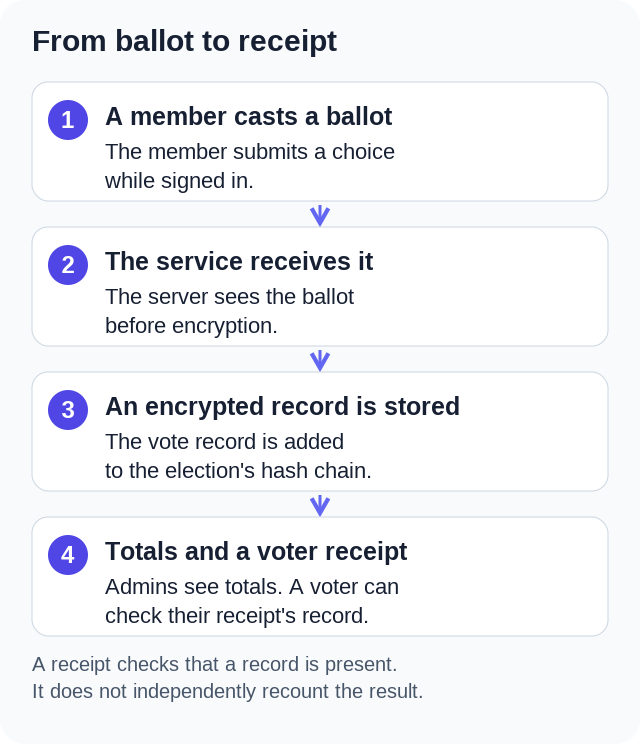
The app sends your choices to the voting service over an encrypted connection, signed in as you. The server receives both who you are and what you chose, then seals the ballot with the election's public key. It keeps the election's private key encrypted at rest and uses it at tally.
After a successful tally, the service deletes the election's private key from the live database, so your organization cannot reopen the ballots for a recount. Our database backups still hold an encrypted copy of that key until they expire, about a week later.
Separate records, written together#
Participation nullifiers and encrypted ballot entries are stored in separate tables, with no column linking one to the other. Both rows are written in the same database transaction, though, and each records its time. No admin screen shows who voted for whom or lists which members voted. Once voting closes, admins see the totals and how many ballots were cast. If only one ballot is cast, or every ballot picks the same option, the results show the choice of anyone known to have voted.
What this does not protect against#
Everything above keeps your choice from other members and from your organization's admins. It does not keep it from us. This is server-side encryption, not end-to-end encryption: our server reads your choice before sealing it, we hold the key behind the nullifiers, and we hold the key that opens the ballots, in the live database until tally and in our backups for about a week after. With database access and those keys, the people who run the service could match a nullifier to its ballot entry and to the member who cast it.
Receipts and the hash chain#
Each ballot receives an entry hash and a position in the chain. The receipt saved on the device you voted from lets you compare those values with the chain metadata the server returns, until you sign out, which deletes it. A mismatch is evidence to investigate.
Keeping a receipt or an independently retained final root helps detect later changes relative to that saved value. A self-consistent chain returned by the same server does not prove that every original choice was represented correctly or tallied honestly. The signed-in chain endpoint omits ciphertext, so members cannot recompute the ballot entry hashes from its response alone. See Check your vote receipt against the election record.
Records and observers#
Election records are protected while voting is open and for at least one calendar year after closure. Owners can extend protection and grant eligible existing members read-only access to a redacted report for that election. The report exposes aggregate evidence, not individual ballots, and does not enable a recount after key destruction. See Election records and observers.
Polls and future voting protocols#
Polls are a different feature. Anonymous polls are anonymous to admins: the results show no names. Poll answers are not encrypted and carry no receipt, and non-anonymous polls can show names. Look for the Anonymous label and use elections when you need encrypted ballots and receipts.
A zero-knowledge voting protocol, designed so that even we could not link a vote to a voter, is in independent security review. It is not used for live elections, and its intended properties are not current guarantees.
For a binding election, have the relevant election officials and advisers review the protocol, observer arrangements, and applicable rules. No legal compliance or independent security certification follows solely from these features.
Read about the primitives and their limits#
libsodium's sealed-box documentation describes public-key encryption, and NIST FIPS 202 defines the SHA-3 hash family. Neither is a security review of One Group Central. Encrypting a ballot after our server receives it does not prevent that server from having seen the authenticated voter and choices.
References checked October 12, 2026. This date records the source-link check, not a human or specialist review of this article.
Published: . Last updated: .