Glossary
What do the portal's terms mean?#
The One Group Central glossary defines the account roles, content types and voting terms used in the member portal. Each definition names its subject so it can be read separately. For longer explanations, follow the linked articles, starting with the FAQ and the Security Overview.
Admin#
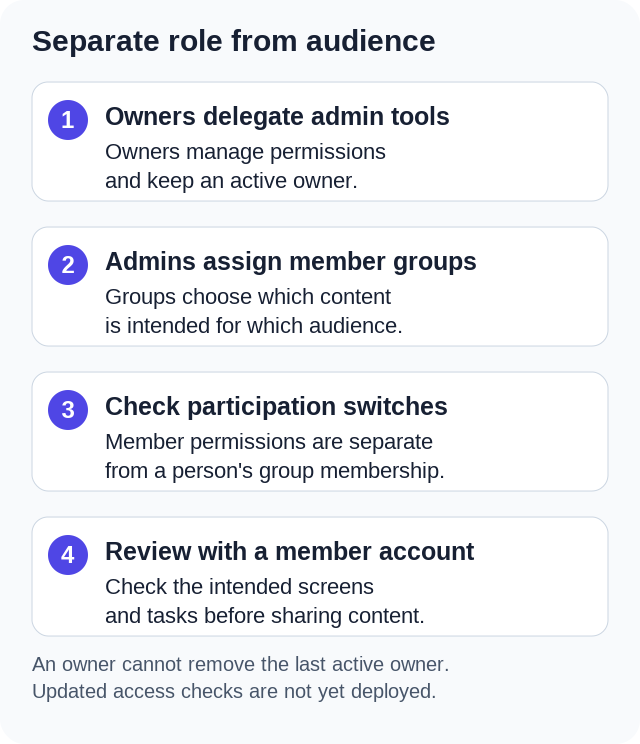
An admin is a member with management access to the Admin Panel. Owners control exactly which admin capabilities each admin has, such as inviting members or sending broadcasts.
Announcement (Broadcast)#
An announcement, also called a broadcast, is a message an admin sends to members by email and push notification. Members read announcements under the home tile labeled "News".
Anonymous voting#
Anonymous voting in One Group Central keeps choices from other members and ordinary admin screens: ballots are encrypted before they are stored, and results show only totals once voting closes. A vote with only one or two ballots can still expose choices through the vote totals, and the protection does not extend to the people who run the service, whose server sees each choice before sealing the ballot. See How Anonymous Voting Works.
Audit log#
The audit log is the organization's record of administrative actions: who did what, when, and from where. Admins with the right permission can review and export it.
Ballot#
A ballot is your set of choices in an election. One Group Central's servers encrypt each ballot when the ballot arrives, before storing it, and each ballot stays sealed until the election is tallied.
Channel#
A channel is a named chat conversation, marked with #, that a set of members shares. Channels can be organization-wide or restricted to specific groups.
Crypto-shred#
Crypto-shred means removing a sensitive document's live encryption key so the app can no longer decrypt it. Earlier database backups can retain the historical wrapped key until they expire. See document encryption for the deletion and backup limits.
Direct message#
A direct message is a private chat between specific members. Organizations can limit direct messages so members can only message owners and admins.
Election#
An election is a formal vote with encrypted ballots, one ballot per member account, results shown only as totals once an admin closes voting, and a receipt each voter can check against the election record. The election workflow has stronger safeguards than a poll, with operator and recount limits described in Help.
Eligibility#
Election eligibility is the set of member accounts allowed to vote, built from the election's groups (or all active members) when it is created. Moving existing members between groups later does not change the eligibility set, but a new member who accepts an invitation while the election is a draft, scheduled or open is added if that member falls within the election's audience. Admins see how many members are eligible, never a list of who voted.
Feature flag (feature toggle)#
A feature flag, also called a feature toggle, is an organization-level switch that turns a whole feature (chat, calendar, polls, and so on) on or off. Turning one off hides the feature for members and blocks it on the server.
Group#
A group is a named subset of members, such as Board or Staff. Groups can target documents, announcements, events, polls, elections, and chat channels at just their members.
Hash chain#
A hash chain is an append-only record where each entry's fingerprint depends on everything before it. Changes can be detected relative to independently retained hashes or receipts. A consistent chain alone does not prove an honest server or tally.
Invite#
An invite is a personal link that lets someone join the portal. Each invite is valid for 7 days and works exactly once.
Member#
A member is a regular user of the portal who reads content, votes, responds to polls, chats, and RSVPs, without management access.
Member directory#
The member directory is the searchable list of members, with names, titles, and a tap-to-email icon. Members' email addresses are never displayed as text to other members.
Multi-select#
Multi-select is a poll or election setting that lets each person pick more than one option, up to a maximum the admin sets.
Nullifier#
A nullifier is a keyed fingerprint made from a member account and an election. The server stores it to refuse a second ballot from that account. A nullifier is a duplicate check, not a privacy guarantee.
Observer#
An election observer is an existing active member granted read-only access to one election's redacted records. The member must already have permission and audience access. A grant does not add voting eligibility or broad audit-log access.
Org slug#
The org slug is your organization's short identifier in the portal address: the part after app.onegroupcentral.com/, made of lowercase letters, numbers, and hyphens.
Owner#
An owner holds the highest role in an organization, with full access to every admin function, including permissions, billing, and cancellation. An organization always keeps at least one owner.
Poll#
A poll is a lightweight question with answer options, optionally anonymous to admins and optionally expiring. A poll is simpler and less formal than an election.
Portal#
A portal is your organization's private, invite-only One Group Central app: documents, announcements, chat, events, polls, the directory, and voting in one place.
Preservation#
Election preservation is a deletion hold on evidence that starts when voting opens and lasts through at least one calendar year after closure. Owners may extend it. Expiration does not automatically delete records. See Election records and observers.
Receipt#
A vote receipt is the confirmation saved in the app on the device you voted from, holding your chain position and entry hash. Signing out deletes the vote receipt. While the receipt is saved, the receipt's "Verify my vote" button checks that the election's vote chain still holds your entry at that position.
RSVP#
An RSVP is your Going, Maybe, or No reply to a calendar event. Admins can see who replied and how.
Sensitive document#
A sensitive document is a file uploaded to the encrypted vault: encrypted at rest with its own key, admin-only by default, viewable only in the memory-only secure viewer, and removed from the live system on delete.
Trial#
The trial is the free 60-day evaluation period a new organization gets, with no credit card required and caps of 25 members, 500 emails per month, and 200 MB storage.
Two-factor authentication (TOTP)#
Two-factor authentication, or TOTP, adds a second sign-in lock: a 6-digit code from an authenticator app, required along with your password. Enable it from your Profile.
Unread badge#
An unread badge is the counter on the Home tab, grid tiles, and app icon showing items you have not opened yet. Opening an item marks it read.
Vote chain#
The vote chain is the append-only hash chain of sealed ballots for an election, summarized by a Merkle root at tally. Signed-in members can check their own receipt against it.
NIST SP 800-88 Rev. 2 describes cryptographic erase as sanitization based on the keys used to encrypt data, the general idea behind the Crypto-shred entry. RFC 6238 defines the time-based one-time password algorithm named in the Two-factor authentication (TOTP) entry. NIST SP 800-88 and RFC 6238 explain the techniques in general; neither reference is an independent review of how One Group Central applies them.
Published: . Last updated: .