Encrypted elections with receipts and aggregate results
Run your vote in the app. Each member gets one ballot. Ballots are encrypted before they are stored, admins see totals only, and each voter gets a receipt they can check.
60 day free trial for up to 25 people. No credit card. Leave any time and take your member list and vote records with you, free.
Published: . Last updated: .
Who can see how a member voted
You want members to vote freely, without the board knowing who chose what. James Folk built encrypted ballots for that reason.
No member or admin screen shows how a named person voted. Everyone sees the totals once you close and count the vote. Totals can still give a vote away. If only a few people vote, or all of them vote the same way, the choices are easy to work out.
Know one limit before you use us for a binding secret ballot. Our server gets each member's name and choices before it encrypts the ballot. We also hold the keys. So the people who run the service could link a ballot to a voter. We do not claim the system is operator-proof.
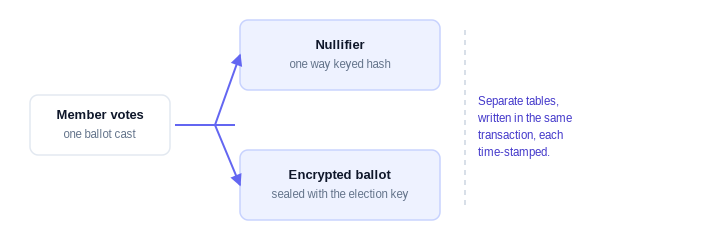
What happens when a member votes
The app checks that the member may vote in this election. It takes one ballot per member account and turns away a second try. Your part is to keep one account per person.
Each vote makes two records. One is a mark that this member voted. The other is the sealed ballot. No screen joins the two. But they are saved at the same moment, and each one keeps its time. That is part of the limit above.
When you count the vote, the app opens the new ballots and saves the totals. Then it deletes that round's key from the live system. After that, your group cannot open those ballots again for a recount. Our backups keep an encrypted copy of the key until the backups expire.
Stop, reopen or count when the board is ready
Close Voting stops the vote but does not count it. The key stays, so an admin with the right access can reopen the vote before it is counted.
An owner can also reopen a vote that was already counted. Members who have not voted can then cast a ballot. New ballots use a new key, and the next count adds them to the totals. It does not recount the old ballots. See the election steps.
What you can set up
- One choice or more than one choice per ballot
- A write-in line on any question you choose, so members can name someone who is not on the list
- A ballot text with bold, lists and links, which you can preview first
- Images and PDFs on the ballot, so members read the contract they vote on in the app
- A vote you open by hand, open right away, or set to open at a set time
- The groups who may vote, with the voter list made when you create the election
- Changes to drafts and scheduled elections before anyone votes
- A way to stop the vote without counting, then reopen or count it later
- A copy of any election, images too, to run the ballot again
- Totals after you close and count
Moving members between groups later does not change who can vote. But a new member who joins while an election is a draft, scheduled or open is added to it if they are in its groups. So the voter list can grow after voting starts. Check that against your own rules.
What a voter can check
Each voter gets a receipt. It holds a code for their ballot and its place in the election record. On the device they voted from, they can check that the record still holds that code in that place. This works until they sign out.
The check looks at that one entry. The record it reads leaves out the ballots, so it cannot recount the vote or check the totals on its own. Read vote receipts and How anonymous voting works.
Records and observers
Opening a vote starts a hold that keeps its records from being deleted. The hold lasts at least one calendar year after the vote closes. Owners can make it longer. They can also let chosen members download a full report with private details taken out. This does not change your groups or prove you meet the law. It also cannot bring back keys for a recount. See Election records and observers.
Read the encryption and hash definitions
The libsodium sealed-box documentation shows how a ballot is sealed. NIST FIPS 202 defines the SHA-3 hash. Neither one reviews One Group Central. Sealing a ballot after we get it does not hide the choices from our service. And a hash record is not a separate count of the vote.
References checked October 12, 2026. This date is when we checked the links. It is not a date of human or expert review of this page.
Before an officer election or ratification
Whether this fits your vote depends on your bylaws, the law that applies to you, how you use observers and what security you need. We claim no certification. We do not claim the app meets every labor election rule. We are also building a zero-knowledge design meant to keep even us from linking a vote to a voter. It is in independent security review and is not used for live elections.
There is no built-in way to match paper ballots with app ballots, or to stop one person from voting both ways. If you also use paper, run its voter checks, its safe keeping and its count on their own. Adding paper totals to app totals does not prove that each person voted once.
Growth measurement and ballot privacy
A change to how we measure growth is waiting to go live. It records an organization's first finished election as a milestone for that organization. It does not send Umami who voted, what anyone chose, or what a member did on the voting screen. This does not change the privacy limits above. Read the security overview and Privacy Policy to see what our analytics collect.
See it in your own organization
60 day free trial for up to 25 people. No credit card. Leave any time and take your member list and vote records with you, free. Every plan includes every feature.