HOA quorum and proxy voting, explained
HOA quorum is the minimum voting power that must be represented before a meeting can act. Check your bylaws and applicable state law for the threshold and which attendance, proxies or advance ballots count. Track each voting interest once. An online vote does not automatically satisfy meeting quorum or authorize proxy voting.
What quorum is and where your number comes from
Quorum is the minimum share of voting power that must participate for a meeting's decisions to be valid. Your number lives in the bylaws, commonly between 10 and 50 percent of total voting interests, sometimes with a lower fallback for reconvened meetings. State statutes often set a default when documents are silent and occasionally set a floor or ceiling.
Quorum is measured in voting interests, not people. One unit usually equals one vote regardless of how many owners it has, and communities with weighted interests count the weights.
What counts toward quorum
- Owners present in person or, where permitted, attending virtually.
- Proxies. A proxy is an absent owner's written authorization for someone present to act for them, and a valid proxy counts its owner as present.
- Advance ballots. In most jurisdictions and under most modern documents, a written or electronic ballot cast before the meeting counts the owner as present for quorum on the matters the ballot covers.
The third category is the one that matters most. If ballots count toward quorum, quorum stops being about who shows up on the night and becomes a question of participation, which you can work on in the two weeks before the meeting.
Proxy voting: the rules that matter
A proxy authorizes another person to vote for you and can be general or directed. An absentee or advance ballot is your own vote, cast before the meeting. Where secret ballots are required, several states replace proxies with absentee style ballots.
- Proxies must be in writing (electronic writings generally qualify) and signed or authenticated by the owner. Your documents may add authentication requirements.
- A general proxy lets the holder vote at their discretion; a directed proxy specifies the owner's choices. Some states require directed proxies for board elections, and some prohibit proxies for secret ballot elections entirely, substituting absentee or electronic ballots.
- Statutes commonly cap how long a proxy stays valid, for example 11 months or a stated term.
- An owner who shows up in person or casts their own ballot revokes the proxy.
- Unlimited proxy collection lets one person control a meeting, so some documents cap how many proxies one holder may carry.
Why communities chronically miss quorum
Paper mechanics suppress participation: the notice goes to a mail pile, the proxy form needs printing and a signature, the meeting is on a weeknight. A failed quorum under those conditions says more about friction than about owner apathy. Voting on a phone takes a couple of minutes, and every step you remove leaves fewer owners who give up partway.
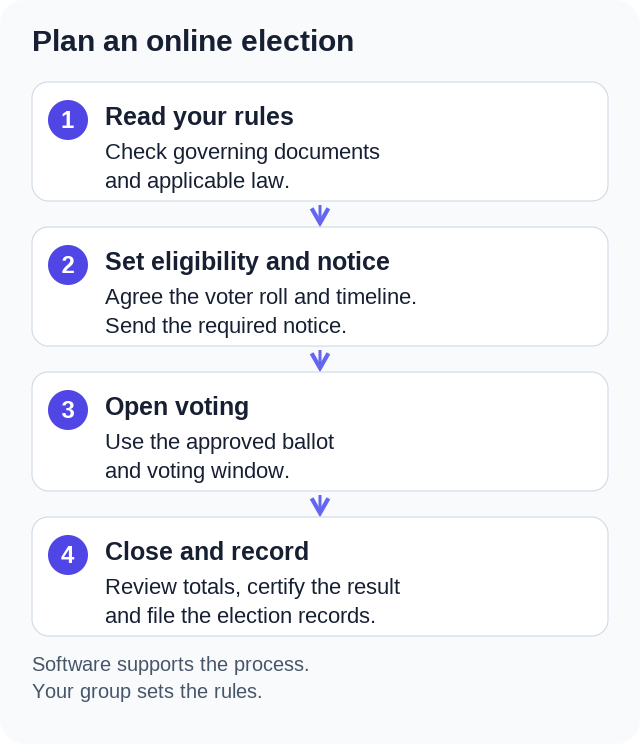
The electronic fix, step by step
- Adopt electronic balloting (see the legal guide for the consent and secret ballot rules).
- Open the ballot window two weeks before the meeting so advance ballots accumulate toward quorum.
- Send reminders during the window as well as the notice at the start.
- Keep a short proxy path for owners who prefer it, and paper ballots for owners who never consented to electronic delivery.
In One Group Central, eligibility is recorded when an election is created, and members who join before it closes can be added. Each eligible member account can cast exactly one ballot (enforced by a keyed nullifier and a database constraint, not by policy), ballots are stored encrypted, and admins see only the totals. The one-ballot limit is per account, not per unit, and ballots are not weighted, so line up accounts with voting interests before the ballot opens. Ballots cast during the advance window are already in when the meeting starts. One Group Central does not track quorum, though, and because ballots are not tied to owners it cannot tell you which units have voted, so settle with your attorney how those ballots will count toward quorum.
How do you avoid counting an owner twice?
Use one row for each voting interest in a quorum worksheet, then record how that interest is represented under your association's rules. Keep a separate tally for each matter if the methods count differently for different matters. The worksheet should track representation; it should not expose choices from a secret ballot.
Illustrative example: assume 100 equal voting interests, a 25 percent quorum and rules that recognize attendance and valid proxies. Eighteen attending interests plus seven distinct proxy interests reach 25. If two of those proxies belong to interests already on the attendance list, only 23 distinct interests are represented. The two records explain the same interests; they do not add voting power.
Before using that method, settle how your rules handle a later personal appearance, a revoked proxy, more than one owner of a unit, unpaid assessments and disputed eligibility. Keep the decision and the supporting document with the worksheet. If voting interests have different weights, replace the equal-interest calculation with the governing documents' weighting rule.
What can One Group Central tell the board about quorum?
One Group Central records one ballot per eligible member account and reports election totals. It does not map accounts to property interests, weight votes, manage proxy appointments or calculate meeting quorum. Its encrypted ballots do not give the board a named list of which owners voted. Build the quorum and eligibility process separately before treating online participation as meeting attendance.
In a practice election, test duplicate submission prevention, ballot choices, the closing time and the receipt check. Separately test the notice, consent, paper alternative and quorum worksheet your association will use. A successful practice vote proves the workflow you tested; it does not certify that the association's election procedure complies with its rules.
Collect ballots before the meeting
Open an electronic election with encrypted ballots weeks ahead, send owners an announcement by email and push, and have the ballots in before anyone arrives.
Start your free trial One-page brief for your board (PDF)