How anonymous online voting works
Anonymous online voting protects a member's choice while checking eligibility and preventing duplicate ballots. Ask who receives the choice, who holds decryption keys and what a receipt proves. One Group Central encrypts ballots before storage and shows officers totals, but receives choices before encryption. Its receipt confirms a record's presence, not an independent recount.
Start with who can receive a choice
Eligibility, duplicate-vote prevention and ballot secrecy are separate checks. A system can enforce one ballot per account while still receiving the member's identity and choice together. Hiding named answers from an administrator's screen does not establish secrecy from the service operator.
Before using a form, survey or election service, ask where the identity check ends and who receives the answer. A setting labeled anonymous does not answer that question by itself. The answer for One Group Central's current ballot path is set out below.
Before a live ballot, show the receipt check
In a nine-question constitution practice test, I showed a participant the receipt check on my screen. The app confirmed the check without an error.
This was a practice demonstration of the app's receipt check. It did not independently verify the tally or establish that a ballot could not be linked to a voter.
If you are introducing the check to your group, show where to use Verify my vote before asking members to rely on it. The receipt guide shows the current screens and explains why the saved receipt stays on the device used to vote.
What a receipt lets a voter check
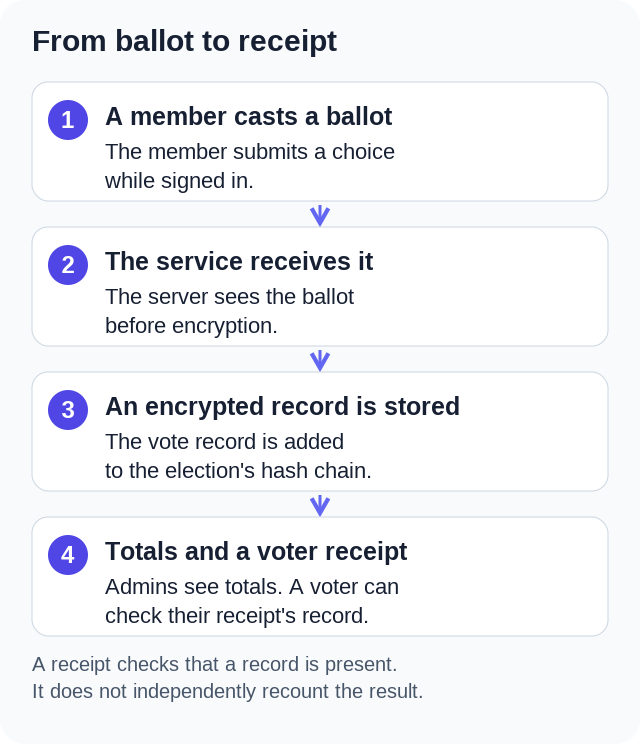
One Group Central keeps each encrypted ballot in an append-only election record, a hash chain in which every entry carries a fingerprint of the entry before it. A voter's receipt is their ballot's position in the election record and the ballot's entry hash. The One Group Central app saves the receipt on the device the member voted from, and while the receipt is saved there, Verify my vote checks that the record our server returns still holds that entry at that position.
The One Group Central receipt check is not a recount. The tally is computed on our servers, a receipt does not show that a selection was encrypted or counted correctly, and because the record and the check both come from our servers, they cannot rule out a change we made consistently across the whole record.
Signing out of One Group Central or clearing the app's data deletes the saved receipt, and it never appears on another device. Copy receipt gives the voter a copy to keep, but nothing in the app checks a pasted copy.
How One Group Central handles a ballot, in plain English
Our current voting closes the survey tool gap for your own officers but not for us. Officers get totals, not ballots, and only after an admin closes and tallies the vote, although in a race with only a few voters a total can still point to one person. We are in a different position: each member's choice reaches our server together with their account, and we hold the keys that encrypt the ballots and later open them for the count. Here is what happens to a ballot:
- When a member votes, the server computes a one way fingerprint, called a nullifier, from their account and the election, and refuses a second ballot carrying the same fingerprint. Anyone holding our HMAC key can recompute it for a given member.
- The server seals the choice with the election's public key before anything is written. The matching private key stays on our server, itself encrypted, until an admin tallies the vote. Close Voting stops new ballots without counting them; Close & Tally counts the ballots and removes that round's key from the live database. The app cannot decrypt those counted ballots again for a recount. Earlier backups retain the encrypted key until they expire.
- The fingerprint and the sealed ballot go into separate tables with no column linking them. The two rows are written in the same database transaction, moments apart, so someone with database access could pair them by timing.
Anonymity v2 is designed so that even the service operator cannot link a vote to a voter. It is in independent security review and is not used for live elections yet. Its intended protection must not be attributed to the current ballot path.
Who needs a secret ballot
- Labor unions use a secret ballot for contract ratifications, strike authorizations, and officer elections, where members expect leadership not to know who voted no. See the union member portal.
- HOAs and condo associations use a secret ballot for board elections and recalls, where neighbors vote about neighbors. See HOA voting software and the step by step election guide.
- Cooperatives need one member, one vote enforced in code rather than in a spreadsheet. See the cooperative voting platform.
- Nonprofits and professional associations vote on board seats, bylaws changes, and disciplinary matters. See the nonprofit member portal and professional association software.
Questions to ask any voting vendor
- Can an administrator, or the vendor itself, connect a voter to a ballot? Ask which protections are enforced by the software, which depend on operations, and what an independent reviewer has verified.
- How is one vote per member enforced: by policy or by the data model?
- What exactly can a voter check with a receipt, and what does that check not prove about the count?
- What is stored, and what would a subpoena of the database actually reveal?
Decide whether this process fits the election
For a union ratification or another binding decision, acceptability depends on the election, applicable law and actual safeguards. One Group Central does not certify LMRDA compliance. Ask counsel and an independent security reviewer to assess the proposed process; an encrypted record or successful receipt check does not settle that decision.
Records and observers
Every election gets a preservation hold when voting opens, and its records are kept for at least one year after it closes. An owner can extend that, and can give an election-specific observer read-only access to a complete redacted JSON review report. These tools support review but do not certify LMRDA compliance. Read the records and observers guide.
Encrypted ballots and a receipt for each voter
One vote per member account, enforced by the system, and a receipt each voter can check, on the device they voted from, to see that their ballot is in the election record. Voting is one part of the all-in-one member portal.
Start your free trial One-page brief for your board (PDF)